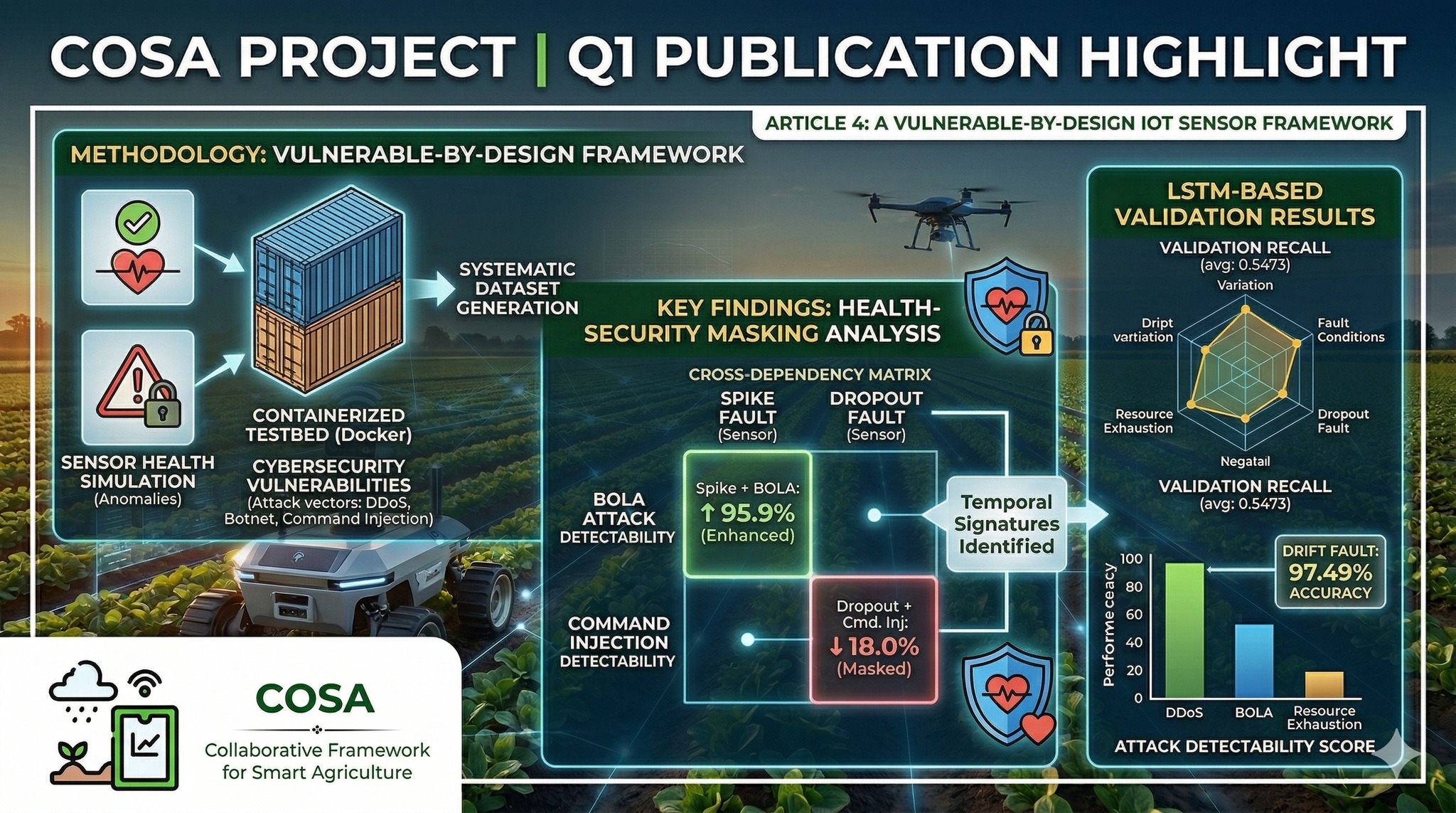
As farms become increasingly connected, the sensors monitoring our crops, soil, and machinery become prime targets for cyberattacks. How do we build better defenses for our food systems? By learning exactly how these digital systems fail.
For our fourth Q1 publication highlight from the COSA project, our team took a bold, proactive approach to agricultural cybersecurity, published in the high-impact journal Agriculture.
The Science Behind the Security
Our researchers engineered a novel “Vulnerable-by-Design” IoT Sensor Framework. Instead of waiting for a real-world cyberattack to occur, the team built a controlled, containerized testbed. This environment deliberately simulates both natural sensor health faults (like signal dropouts) and active cybersecurity attacks to rigorously test and validate our detection capabilities using advanced LSTM (Long Short-Term Memory) neural networks.
Key Impact for Smart Agriculture
- Proactive Defense: By intentionally building vulnerable systems, we can identify and fix weaknesses before malicious actors exploit them in the field.
- Real-World Readiness: Our framework provides a safe sandbox to test, identify, and patch vulnerabilities before they can be exploited in real-world smart agriculture deployments.
By understanding the weaknesses, COSA is helping to engineer the next generation of resilient, secure smart farms. Huge congratulations to Emil Pasca, Darius Delinschi, Raul Erdei, Ioan Baraian, and Oliver Matei on this vital research!
Read the full open-access publication here:
Pasca, E., Delinschi, D., Erdei, R., Baraian I. & Matei, O. (2025). A Vulnerable-by-Design IoT Sensor Framework for Cybersecurity in Smart Agriculture. Agriculture 2025, 15, 1253.
https://www.mdpi.com/2077-0472/15/12/1253

0 Comments