
Use Case 3 – Local Producer Marketplace
A digital platform for the smart agriculture supply chain, built around the Short Food Supply Chain (SFSC) model.

Overview
Use Case 3 of the COSA project addresses one of the most pressing questions in modern agri-food systems: how can local producers and consumers connect directly through a digital channel, while at the same time generating the real-world data needed to advance research in smart agriculture and supply-chain optimisation?
The use case takes the form of a Local Producer Marketplace, a digital platform that unifies multiple local producer storefronts into a single, searchable ecosystem — a “marketplace of marketplaces”. It serves simultaneously as a digital tool for rural communities and as a real-world testbed for the COSA research team.
The platform is publicly available at uc3cosa.cunbm.utcluj.ro.
Core Concept
Use Case 3 implements a Short Food Supply Chain (SFSC) model. Local producers from the Baia Mare region publish their products through individual storefronts. Consumers browse, compare and order across all producers in one unified interface, with a shared shopping cart and delivery options. All transactions, locations and product data are fed back into the COSA research pipeline as anonymised, high-quality data for optimisation research.
Platform objectives
- Producer visibility — enable local farmers to reach new customers digitally, with zero technological barriers.
- Data generation — collect real-world supply-chain data (orders, quantities, locations, timing) for use in COSA research.
- Rural economy support — strengthen local agricultural communities by reducing dependence on intermediaries.
- Optimisation testbed — provide real-world validation grounds for routing and scheduling algorithms developed within COSA.
Technical architecture
The platform is built on a WordPress-based core, leveraging industry-standard open-source eCommerce, multi-vendor and data-analytics technologies. It is structured in clear functional layers:
- Frontend layer — consumer interface: product browsing, cart management, order placement, responsive design.
- Vendor layer — producer dashboard: individual branded storefronts, inventory management, order tracking.
- Data layer: transaction data (orders, quantities, timing patterns), location data (producer and customer coordinates), product data (categories, pricing, availability).
- Research API: exposes the aggregated, anonymised data to the COSA optimisation algorithms.
Product categories
Producers in the Baia Mare region offer products across a wide range of categories, including: beekeeping (honey, propolis, apilarnil), dairy & eggs (fresh milk, cheese, eggs), vegetables (tomatoes, greens, roots), fruits (seasonal and organic produce), meat products, bakery, beverages, poultry, nuts & seeds. New categories are added as more local producers join the platform.
Research applications
The marketplace provides a unique source of real-world data for several classes of optimisation problems studied within COSA:
- Vehicle Routing Problem (VRP) — optimising delivery routes across multiple producer locations.
- Capacitated VRP — handling vehicle-capacity constraints for perishable goods.
- Time-Windows VRP — delivery scheduling that respects freshness requirements and customer preferences.
- Multi-Depot VRP — managing logistics from multiple producer origin points.
These optimisation problems are tackled using AI and metaheuristics — including the hybrid genetic algorithms, clustered routing approaches and evolutionary encodings published by the COSA team. The platform generates four key categories of data for research: geographic data (locations, delivery zones, distance matrices), demand patterns (order volumes, seasonality, preferences), temporal data (time windows, peak hours, service times) and research outputs made available as open testbeds for the academic community.
Platform features
For consumers — browse all local producers in one place, unified shopping cart across vendors, wishlist and favourites, home delivery options, multiple payment methods. Consumer value: fresh, authentic products at a click.
For producers — personal branded storefront, easy product management dashboard, order tracking and notifications, sales analytics and reporting, digital promotion tools. Producer value: digital presence with zero tech barriers.
Expected impact
- Economic: new revenue streams for local farmers, reduced intermediary costs, preservation of rural employment, digital-economy inclusion.
- Scientific: real-world optimisation datasets, testbed for VRP algorithm validation, AI/ML research contributions, open data for the academic community.
- Social: producer–consumer trust building, preservation of traditional food, support for sustainable agriculture, community resilience.
Selected publications related to this use case
- P. C. Pop, O. Cosma, C. Sabo, C. Pop Sitar, «A comprehensive survey on the generalized traveling salesman problem,» European Journal of Operational Research, Elsevier, 2023. (Q1)
- O. Cosma, P. C. Pop, L. Cosma, «A hybrid based genetic algorithm for solving the clustered generalized traveling salesman problem,» HAIS 2023.
- C. Sabo, P. C. Pop, A. Petrovan, «A comparison of different crossover operators in genetic algorithms for clustered shortest-path tree problem,» CIE 50, 2024.
- C. Sabo, B. Teglaș, P. C. Pop, A. Petrovan, «Solving the clustered minimum routing tree problem using Prüfer-coding based hybrid genetic algorithms,» HAIS 2024.
- A. Tatar, N. Fat, A. Petrovan, O. Matei, «A new vision of social behavior on genetic algorithm performance,» SOCO 2024.
- C. Sabo, N. Balogh, P. C. Pop, A. Petrovan, «A comparative study of different genetic algorithms approaches to capacitated vehicle routing problem for collection of agricultural products,» SOCO 2024.
- C. Sabo, P. C. Pop, B. Teglaș, A. Petrovan, «Competition between Dandelion and Prüfer encoded genetic algorithms for solving the clustered minimum routing tree problem,» Carpathian Journal of Mathematics, 2025. (Q1)
Publications related to UC3 — Local Producer Marketplace
Competition between Dandelion and Prüfer encoded genetic algorithms for solving the clustered minimum routing tree problem
Competition between Dandelion and Prüfer encoded genetic algorithms for solving the clustered minimum routing tree problemCosmin Sabo, Petrică C. Pop, Bogdan Teglaș, Adrian Petrovan Abstract. The Clustered Minimum Routing Tree Problem (CluMRTP) is a challenging...
Solving the clustered minimum routing tree problem using Prüfer-coding based hybrid genetic algorithms
Solving the clustered minimum routing tree problem using Prüfer-coding based hybrid genetic algorithmsCosmin Sabo, Bogdan Teglaș, Petrică C. Pop, Adrian Petrovan Abstract. The clustered minimum routing tree problem (CluMRTP) extends the classical minimum routing tree...

A new vision of social behavior on genetic algorithm performance
A new vision of social behavior on genetic algorithm performanceAndreea Tatar, Nicolae Fat, Adrian Petrovan, Oliviu Matei Abstract. Genetic algorithms (GAs) are typically described in terms of mutation, crossover and selection, but the social dynamics that arise...
A comparative study of different genetic algorithms approaches to capacitated vehicle routing problem for collection of agricultural products
A comparative study of different genetic algorithms approaches to capacitated vehicle routing problem for collection of agricultural productsCosmin Sabo, Natanael Balogh, Petrică C. Pop, Adrian Petrovan Abstract. In this study, we tackle a local collection challenge,...
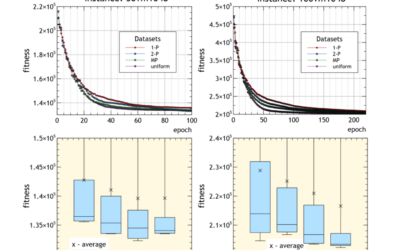
A Comparison of different crossover operators in genetic algorithms for clusters shortest-path tree problem
The clustered shortest-path tree (CluSPT) problem is an extension of the classical shortest path problem, given a graph with the nodes partitioned into several mutually exclusive and collectively exhaustive clusters looks for a shortest-path spanning tree from a predefined source node to all the other nodes of the graph, with the property that every cluster should generate a connected subgraph.
A comprehensive survey on the generalized traveling salesman problem
The generalized traveling salesman problem (GTSP) is an extension of the classical traveling salesman
problem (TSP), and it is among the most researched combinatorial optimization problems due to its theoretical properties, complexity aspects, and real-life applications in various areas: location-routing problems, material flow design problem, distribution of medical supplies, urban waste collection management, airport selection and routing the courier airplanes, image retrieval and ranking, digital garment manufacturing, etc.
A hybrid based genetic algorithm for solving the clustered generalized traveling salesman problem
We study the clustered generalized traveling salesman problem (CGTSP), which is an extension of the generalized traveling salesman problem (GTSP), which in turn generalizes the well-known traveling salesman problem (TSP).