
Use Case 2 – Aerial Crop Monitoring and Precision Treatment
Using drones and aerial imagery to detect crop conditions and apply precise, targeted treatments.

Overview
Use Case 2 of the COSA project addresses a critical operational question in modern agriculture: how do we identify, in time, the parts of a field that need intervention — and how do we treat them precisely, with minimum waste and environmental impact? The use case combines aerial imagery captured by drones with computer-vision models and decision-support algorithms to detect anomalous crop conditions, and then plans precision treatments performed by drones.
Scope
- Aerial data acquisition — drones equipped with optical and multispectral sensors fly over crop fields and capture high-resolution imagery and spectral data.
- Detection of crop conditions — computer-vision and deep-learning models analyse the aerial imagery to detect diseases, pests, water stress and other anomalies at the level of individual parcels or even individual plants.
- Treatment planning — based on the detection results, the system plans targeted treatments (precision spraying, irrigation adjustment, mechanical intervention) at the relevant geographic locations.
- Precision execution — drones execute the planned treatments through precision spraying, ensuring that agro-chemicals are applied only where they are needed and in the required quantities.
Methodology
- Sensing layer — drone-mounted cameras and multispectral sensors collect data over the area of interest, with flight plans designed to balance coverage and battery autonomy.
- Perception layer — convolutional neural networks (CNNs) and other deep-learning models classify and localise anomalies (e.g. plant diseases, pest infestations) in the imagery.
- Decision layer — a decision-support module combines detection results with agronomic rules to plan treatments at the right intensity and location.
- Action layer — drones execute precision spraying or related actions according to the generated treatment plan.
Our Field Collaborators
To ground the research in real-world conditions, the COSA team collaborates with agricultural partners from Maramureș county that bring concrete challenges from organic and conventional farming:
Fermierul Moroșan (Cernești, Maramureș) manages 1.1 hectares of greenhouses, dedicating 0.72 hectares to the cultivation of organic tomatoes (around 80,000 plants that can grow up to 4 meters tall). As an organic farm, no chemicals are used; resilient Romanian tomato varieties are cultivated with natural fertilizers. The farm has supply contracts with four major retailers — Mega Image, Lidl, Kaufland and Carrefour. In recent seasons, the farm faced challenges that directly motivate Use Case 2: infestations of the tomato moth (Tuta absoluta) and aphids, as well as magnesium deficiency in the plants. Since no chemicals can be used, affected leaves must be manually collected and burned — a complex task given the height of the plants and the size of the cultivated area. Early image-based detection is therefore directly actionable.
Morile Mătieș (Mireșu Mare, Maramureș) cultivates 170 hectares of rapeseed, corn, sunflower and wheat. By employing modern farming technology and advanced agricultural engineering, the farm consistently produces high-quality grains for its own processing units. The scale and crop diversity make this farm an excellent partner for validating drone-based aerial monitoring and multispectral analysis.
These collaborations enable us to enhance the research on monitoring the health of agricultural crops through image analysis, and to develop more effective and accurate models for detecting various issues affecting crop health.
Selected publications related to this use case
- O. Cosma, L. Cosma, «A Novel CNN Approach for Accurate Tomato Disease Classification,» Proc. 30th ICE/IEEE ITMC Conf., 2024.
- O. Cosma, L. Cosma, «TPC Net: An Efficient CNN Architecture for Tomato Plant Disease and Pest Classification,» SOCO 2024.
- M. Măcelaru, P. Pop, J. Barata, «A comparative study of machine learning models for plant disease identification,» SOCO 2024.
- E. M. Pasca, D. Delinschi, R. Erdei, I. Băărăian, O. Matei, «A Vulnerable-by-Design IoT Sensor Framework for Cybersecurity in Smart Agriculture,» Agriculture (Basel), MDPI, 2025. (Q1)
- M. Măcelaru, P. C. Pop, R. Chiuzbăian, N. Kovacs, «An Enhanced Hybrid Machine Learning Model for Plant Disease Detection and Classification,» HAIS 2025, Lecture Notes in Computer Science, vol. 16202, Springer, 2026, pp. 91–102. DOI: 10.1007/978-3-032-08465-1_8.
Expected impact
- Sustainable agriculture — treatments are applied only where needed, drastically reducing the use of water, fertiliser and pesticides.
- Yield protection — early detection of diseases and pests allows farmers to act before significant damage occurs.
- Operational efficiency — automated drone-based monitoring and treatment reduces labour cost and increases the frequency at which large fields can be inspected.
Publications related to UC2 — Aerial Crop Monitoring
An Enhanced Hybrid Machine Learning Model for Plant Disease Detection and Classification
An Enhanced Hybrid Machine Learning Model for Plant Disease Detection and ClassificationMara Măcelaru, Petrică C. Pop, Rareș Chiuzbăian, Norbert Kovacs Abstract. Timely and precise detection of plant diseases plays a crucial role in ensuring good agricultural...
A Vulnerable-by-Design IoT Sensor Framework for Cybersecurity in Smart Agriculture
A Vulnerable-by-Design IoT Sensor Framework for Cybersecurity in Smart AgricultureEmil Marian Pasca, Daniela Delinschi, Rudolf Erdei, Iulia Băărăian, Oliviu Matei Abstract. As farms become increasingly connected, the sensors monitoring crops, soil and machinery become...
A Novel CNN Approach for Accurate Tomato Disease Classification
A Novel CNN Approach for Accurate Tomato Disease ClassificationOvidiu Cosma, Laura Cosma Abstract. Plant diseases pose significant threats to agriculture, leading to substantial yield losses worldwide. Tomato crops are particularly affected by a wide range of...
TPC Net: An Efficient CNN Architecture for Tomato Plant Disease and Pest Classification
TPC Net: An Efficient CNN Architecture for Tomato Plant Disease and Pest ClassificationOvidiu Cosma, Laura Cosma Abstract. Tomato crops are affected by a wide variety of diseases and pests that can dramatically reduce both yield and quality. This paper presents...
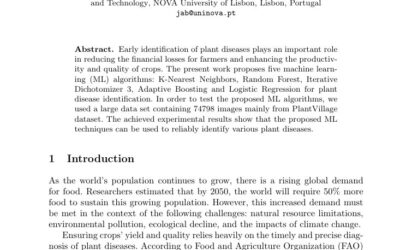
A comparative study of machine learning models for plant disease identification
A comparative study of machine learning models for plant disease identificationMăcelaru Mara, Petrică Pop, Jose Barata Abstract. Plant disease identification from images is a central task in precision agriculture, but the rapid evolution of machine learning makes it...