
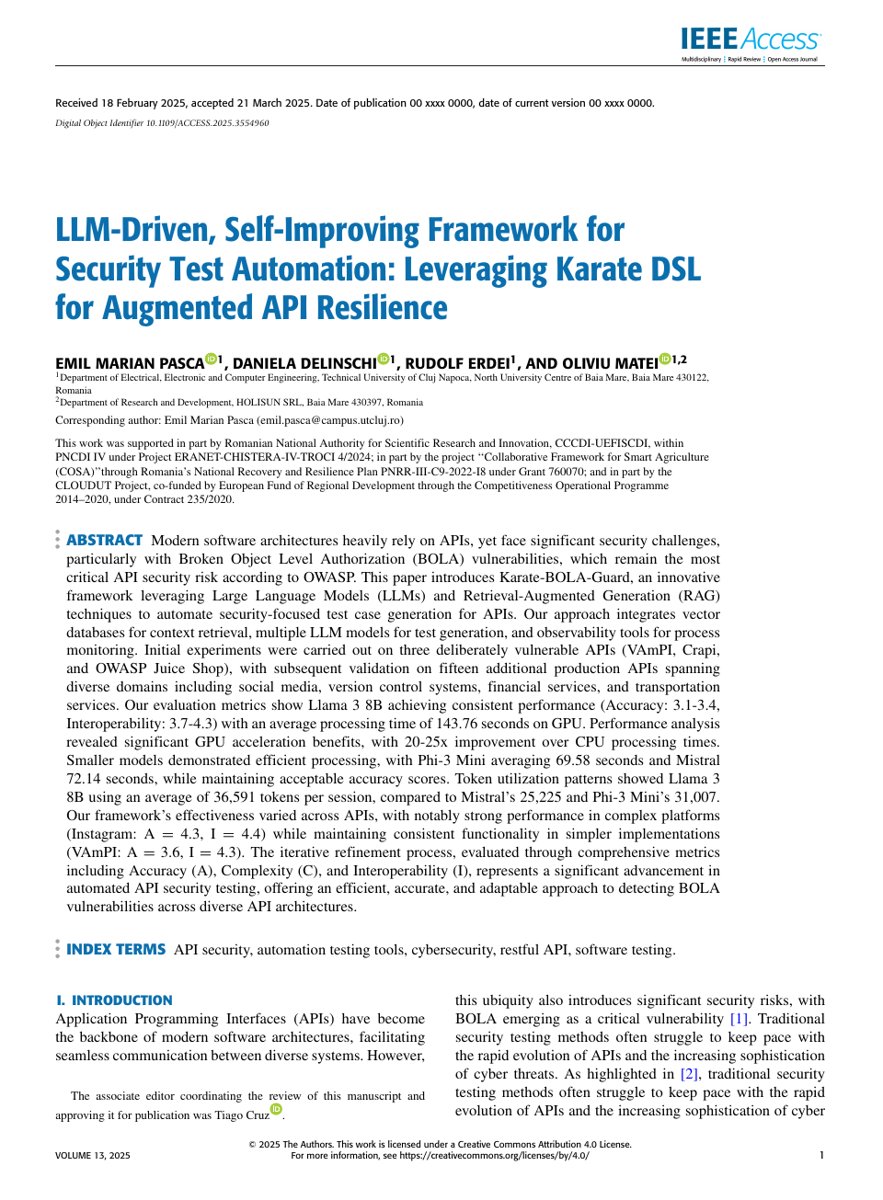
LLM-Driven, Self-Improving Framework for Security Test Automation: Leveraging Karate DSL for Augmented API Resilience
LLM-Driven, Self-Improving Framework for Security Test Automation: Leveraging Karate DSL for Augmented API Resilience
Emil Marian Pasca, Daniela Delinschi, Rudolf Erdei, Oliviu Matei
Abstract. This paper introduces Karate-BOLA-Guard, an LLM-driven, self-improving framework for security test automation that leverages the Karate DSL to enhance API resilience. The framework combines Large Language Models with Retrieval-Augmented Generation (RAG) techniques to automatically synthesize security-focused test cases, with particular emphasis on Broken Object Level Authorization (BOLA) and related authorization issues. A feedback loop allows the system to refine the generated tests based on past execution results, vulnerability reports and updated API specifications. Experimental results on representative APIs demonstrate that the framework substantially increases security test coverage and detection rates while reducing manual effort, contributing to more resilient and continuously protected APIs.
Keywords: API security; LLM; Karate DSL; BOLA; self-improving frameworks; security test automation
📋 Cite this publication
Emil Marian Pasca, Daniela Delinschi, Rudolf Erdei, Oliviu Matei, "LLM-Driven, Self-Improving Framework for Security Test Automation: Leveraging Karate DSL for Augmented API Resilience", IEEE Access, vol. 13, 2025, 2023. DOI: https://doi.org/10.1109/ACCESS.2025.3554960.
Reference: IEEE Access, vol. 13, 2025. DOI: 10.1109/ACCESS.2025.3554960
A comparative study of different genetic algorithms approaches to capacitated vehicle routing problem for collection of agricultural products
A comparative study of different genetic algorithms approaches to capacitated vehicle routing...
Using Machine Learning for Identifying the Intrinsic Economic Specializations of Localities
Using Machine Learning for Identifying the Intrinsic Economic Specializations of LocalitiesOliviu...
Embedding GIS in crop field bonitation computation
Embedding GIS in crop field bonitation computationBogdan Văduva, Oliviu Matei, Anca Avram, Laura...

A comparative study of machine learning models for plant disease identification
A comparative study of machine learning models for plant disease identificationMăcelaru Mara,...
A Novel CNN Approach for Accurate Tomato Disease Classification
A Novel CNN Approach for Accurate Tomato Disease ClassificationOvidiu Cosma, Laura Cosma Abstract....
Design of a collaborative network for mapping digital skills for Industry 5.0
Design of a collaborative network for mapping digital skills for Industry 5.0Maria Gustavsson,...
Solving the clustered minimum routing tree problem using Prüfer-coding based hybrid genetic algorithms
Solving the clustered minimum routing tree problem using Prüfer-coding based hybrid genetic...

Augmenting API Security Testing with Automated LLM-Driven Test Generation
Augmenting API Security Testing with Automated LLM-Driven Test GenerationEmil Marian Pasca, Rudolf...
Data Quality Assessment Methodology
Data Quality Assessment MethodologyDaniela Delinschi, Rudolf Erdei, Emil Pasca, Oliviu Matei...

Privacy Assessment Methodology for Machine Learning Models and Data Sources
Privacy Assessment Methodology for Machine Learning Models and Data SourcesRudolf Erdei, Emil...
Aggregation Strategy for Federated Machine Learning Algorithm
Aggregation Strategy for Federated Machine Learning AlgorithmRudolf Erdei, Daniela Delinschi,...
Using Markov chains for determining the proximity contagion of smart specialization of localities
Using Markov chains for determining the proximity contagion of smart specialization of...

0 Comments