
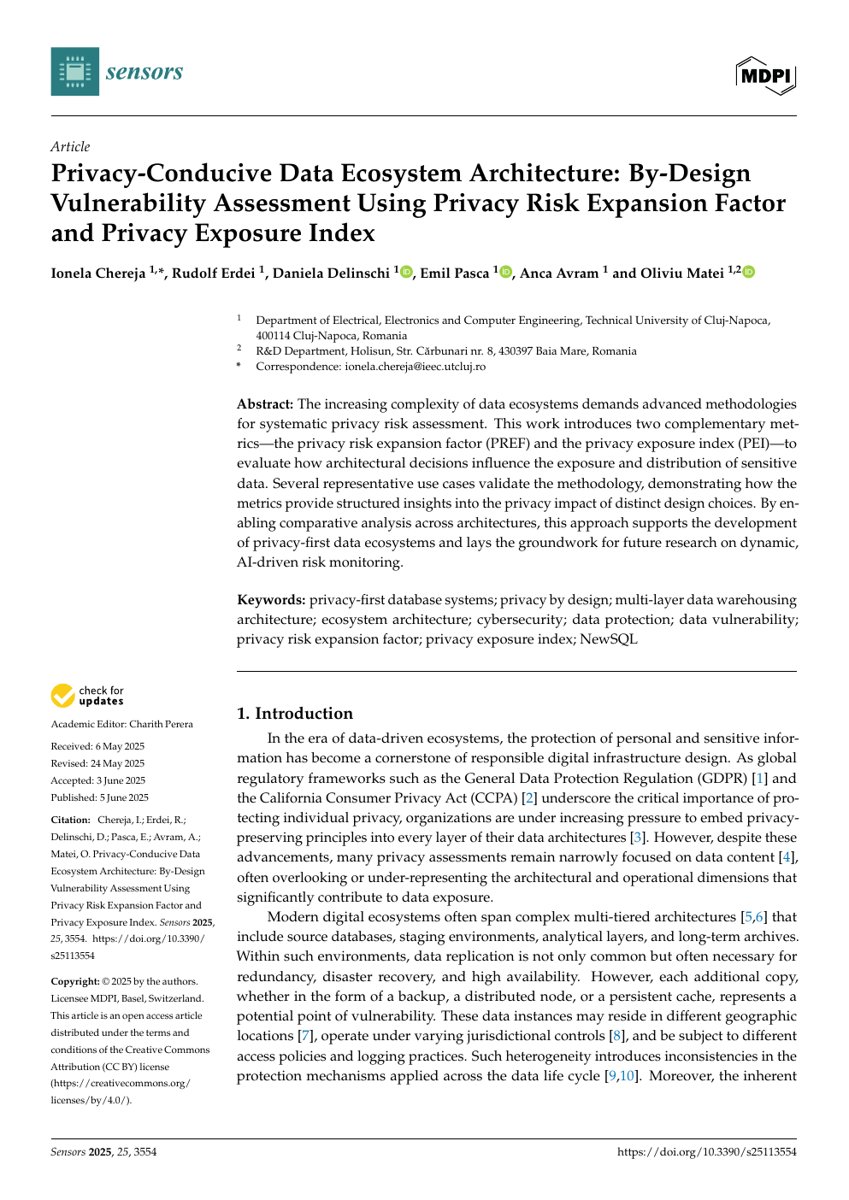
Privacy-Conducive Data Ecosystem Architecture: By-Design Vulnerability Assessment Using Privacy Risk Expansion Factor and Privacy Exposure Index
Privacy-Conducive Data Ecosystem Architecture: By-Design Vulnerability Assessment Using Privacy Risk Expansion Factor and Privacy Exposure Index
Ionela Chereja, Rudolf Erdei, Daniela Delinschi, Emil Pasca, Anca Avram, Oliviu Matei
Abstract. Modern data ecosystems integrate heterogeneous sources, processing layers and stakeholders, making the by-design assessment of privacy vulnerabilities particularly challenging. This paper proposes a Privacy-Conducive Data Ecosystem Architecture that supports by-design vulnerability assessment using two novel metrics: the Privacy Risk Expansion Factor and the Privacy Exposure Index. The expansion factor quantifies how privacy risks propagate through different architectural layers and integration points, while the exposure index aggregates these risks into a single, interpretable score. The architecture and metrics are validated on representative IoT and smart agriculture scenarios, demonstrating their usefulness for designing ecosystems that are inherently more privacy-respectful.
Keywords: privacy by design; data ecosystem; vulnerability assessment; privacy risk; IoT; smart agriculture
📋 Cite this publication
Ionela Chereja, Rudolf Erdei, Daniela Delinschi, Emil Pasca, Anca Avram, Oliviu Matei, "Privacy-Conducive Data Ecosystem Architecture: By-Design Vulnerability Assessment Using Privacy Risk Expansion Factor and Privacy Exposure Index", Sensors (Basel), vol. 25, no. 11, MDPI, 2025, 2023. DOI: https://doi.org/10.3390/s25113554.
Reference: Sensors (Basel), vol. 25, no. 11, MDPI, 2025. DOI: 10.3390/s25113554

Privacy Assessment Methodology for Machine Learning Models and Data Sources
Privacy Assessment Methodology for Machine Learning Models and Data SourcesRudolf Erdei, Emil...
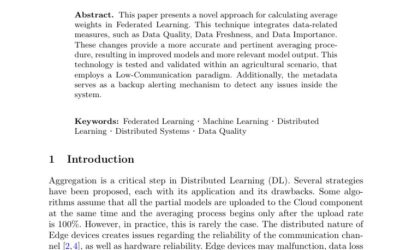
Aggregation Strategy for Federated Machine Learning Algorithm
Aggregation Strategy for Federated Machine Learning AlgorithmRudolf Erdei, Daniela Delinschi,...
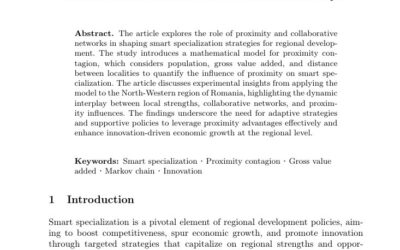
Using Markov chains for determining the proximity contagion of smart specialization of localities
Using Markov chains for determining the proximity contagion of smart specialization of...
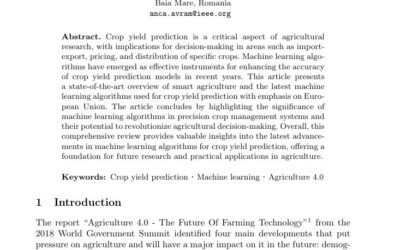
Advancements in Machine Learning Algorithms for Precision Crop Yield Prediction: A Comprehensive Review with focus on European Union
Advancements in Machine Learning Algorithms for Precision Crop Yield Prediction: A Comprehensive...
TPC Net: An Efficient CNN Architecture for Tomato Plant Disease and Pest Classification
TPC Net: An Efficient CNN Architecture for Tomato Plant Disease and Pest ClassificationOvidiu...
Enhancing API Security Testing against BOLA and Authentication Vulnerabilities through an LLM-Enhanced Framework
Enhancing API Security Testing against BOLA and Authentication Vulnerabilities through an...
A new vision of social behavior on genetic algorithm performance
A new vision of social behavior on genetic algorithm performanceAndreea Tatar, Nicolae Fat, Adrian...
A comparative study of different genetic algorithms approaches to capacitated vehicle routing problem for collection of agricultural products
A comparative study of different genetic algorithms approaches to capacitated vehicle routing...
Using Machine Learning for Identifying the Intrinsic Economic Specializations of Localities
Using Machine Learning for Identifying the Intrinsic Economic Specializations of LocalitiesOliviu...
Embedding GIS in crop field bonitation computation
Embedding GIS in crop field bonitation computationBogdan Văduva, Oliviu Matei, Anca Avram, Laura...
A comparative study of machine learning models for plant disease identification
A comparative study of machine learning models for plant disease identificationMăcelaru Mara,...
A Novel CNN Approach for Accurate Tomato Disease Classification
A Novel CNN Approach for Accurate Tomato Disease ClassificationOvidiu Cosma, Laura Cosma Abstract....

0 Comments