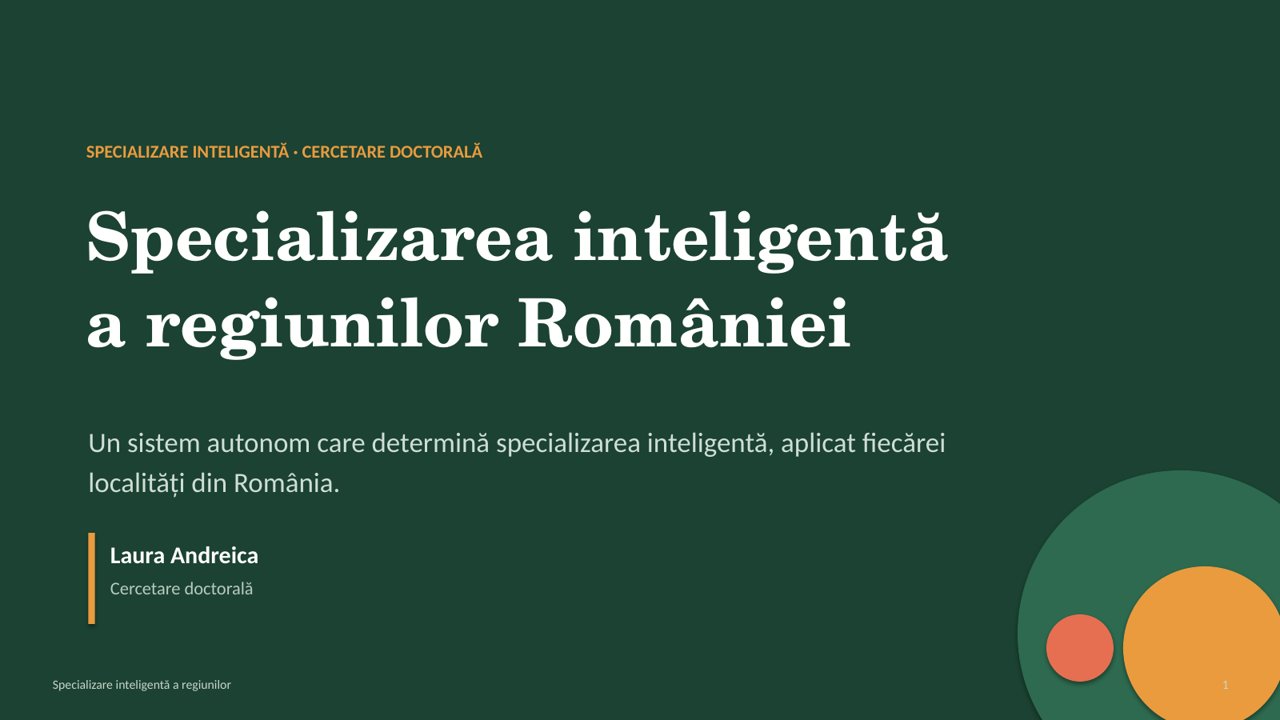
Laura Andreica presented her doctoral research on the smart specialisation of Romanian regions — an autonomous system that determines the optimal specialisation for each locality in Romania.
The problem
Today, the specialisation of a region is often decided on intuition, lobbying or assumptions. The mechanisms by which innovation propagates between regions remain poorly quantified, and decision-makers lack an objective instrument that simultaneously integrates local economy, environment, infrastructure and proximity dynamics.
The approach — eight layers of analysis
The application integrates eight complementary perspectives to determine the optimal specialisation of each locality:
- Intrinsic economic specialisation
- Proximity contagion
- Economic value chain
- Environmental indicators
- Infrastructure
- Demographic indicators
- Educational ecosystem
- Innovation potential
Mathematical core
Layers 1 and 2 form the mathematical nucleus of the system. Intrinsic specialisation uses turnover (CA) and CAEN codes (2 digits) as data sources, with machine learning methods (PCA, SVM, Relief weighting, information gain) identifying the determinants of the local economy. The result is the CAEN code that captures the locality's economic identity. Proximity contagion measures how economic influence propagates between neighbouring localities, generating influence maps usable by decision-makers.
Application: the AEGIS platform
The doctoral research is materialised in the AEGIS Smart Specialization Platform, developed by HOLISUN as a decision-support dashboard for the intelligent economic specialisation of localities — one of the three public platforms produced by the COSA project.
Presentation slides
View the full slide deck below — or open the PDF in a new tab / download.
If the PDF does not render in your browser, please use the "open" or "download" link above.

0 Comments