
Aggregation Strategy for Federated Machine Learning Algorithm
Aggregation Strategy for Federated Machine Learning Algorithm
Rudolf Erdei, Daniela Delinschi, Iulia Băărăian, Oliviu Matei
Abstract. Federated learning allows multiple parties to collaboratively train a model without sharing their raw data, but the quality of the final model strongly depends on the aggregation strategy used to combine local updates. This work introduces an aggregation strategy designed for heterogeneous data sources typical of smart agriculture deployments, where clients differ in dataset size, data distribution and computational capacity. The proposed strategy adjusts the contribution of each client based on a combination of data quality and reliability indicators, while preserving privacy guarantees. Empirical evaluation shows improvements in model convergence and robustness compared to standard federated averaging baselines.
Keywords: federated learning; aggregation strategy; heterogeneous clients; smart agriculture; collaborative AI
📋 Cite this publication
Rudolf Erdei, Daniela Delinschi, Iulia Băărăian, Oliviu Matei, "Aggregation Strategy for Federated Machine Learning Algorithm", Proc. 19th SOCO Int. Conf. on Soft Computing Models in Industrial and Environmental Applications, Springer, 2024, 2023.
Reference: Proc. 19th SOCO Int. Conf. on Soft Computing Models in Industrial and Environmental Applications, Springer, 2024.

A new vision of social behavior on genetic algorithm performance
A new vision of social behavior on genetic algorithm performanceAndreea Tatar, Nicolae Fat, Adrian...
A comparative study of different genetic algorithms approaches to capacitated vehicle routing problem for collection of agricultural products
A comparative study of different genetic algorithms approaches to capacitated vehicle routing...
Using Machine Learning for Identifying the Intrinsic Economic Specializations of Localities
Using Machine Learning for Identifying the Intrinsic Economic Specializations of LocalitiesOliviu...
Embedding GIS in crop field bonitation computation
Embedding GIS in crop field bonitation computationBogdan Văduva, Oliviu Matei, Anca Avram, Laura...
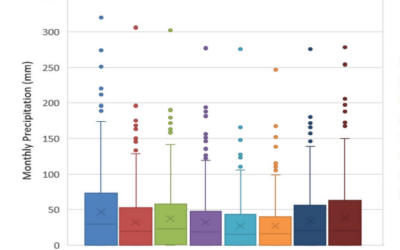
Evaluation of Feature Selection Methods in Estimation of Precipitation Based on Deep Learning Artificial Neural Networks
Precipitation is the most important element of the water cycle and an indispensable element of water resources management. This paper aims to model the monthly precipitation in 8 precipitation observation stations. The effects and role of different feature weights pre-processing methods (Weight by deviation, Weight by PCA, Weight by correlation, and Weight by Support Vector Machine) on artificial intelligence modeling were investigated.
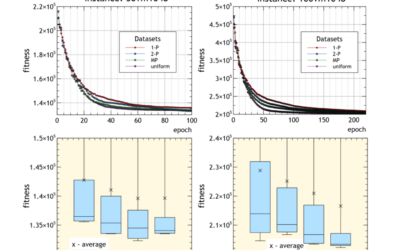
A Comparison of different crossover operators in genetic algorithms for clusters shortest-path tree problem
The clustered shortest-path tree (CluSPT) problem is an extension of the classical shortest path problem, given a graph with the nodes partitioned into several mutually exclusive and collectively exhaustive clusters looks for a shortest-path spanning tree from a predefined source node to all the other nodes of the graph, with the property that every cluster should generate a connected subgraph.

A comprehensive survey on the generalized traveling salesman problem
The generalized traveling salesman problem (GTSP) is an extension of the classical traveling salesman
problem (TSP), and it is among the most researched combinatorial optimization problems due to its theoretical properties, complexity aspects, and real-life applications in various areas: location-routing problems, material flow design problem, distribution of medical supplies, urban waste collection management, airport selection and routing the courier airplanes, image retrieval and ranking, digital garment manufacturing, etc.

A hybrid based genetic algorithm for solving the clustered generalized traveling salesman problem
We study the clustered generalized traveling salesman problem (CGTSP), which is an extension of the generalized traveling salesman problem (GTSP), which in turn generalizes the well-known traveling salesman problem (TSP).

0 Comments