
Evaluation of Feature Selection Methods in Estimation of Precipitation Based on Deep Learning Artificial Neural Networks
Evaluation of Feature Selection Methods in Estimation of Precipitation Based on Deep Learning Artificial Neural Networks
Mohammad Taghi Sattari, · Anca Avram, · Halit Apaydin, · Oliviu Matei
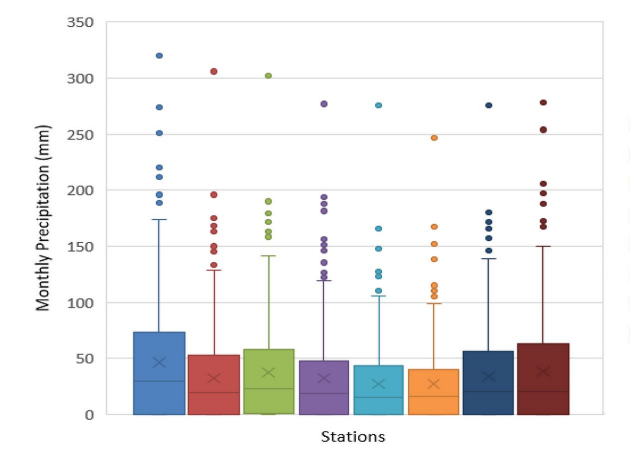
Abstract. Precipitation is the most important element of the water cycle and an indispensable element of water resources management. This paper’s aim is to model the monthly precipitation in 8 precipitation observation stations in the province of Hamadan, Iran. The effects and role of different feature weights pre-processing methods (Weight by deviation, Weight by PCA, Weight by correlation, and Weight by Support Vector Machine) on artificial intelligence modeling were investigated. Deep learning methods were applied based on a multi-layer feed-forward artificial neural network that is trained with Stochastic Gradient Descent using back-propagation (DL-SGD) and Convolutional Neural Networks (CNN) modeling. The precipitation of each station is modeled using the precipitation values of the other stations. The best result, among all scenarios, at the Vasaj station according to the DL-SGD method (CC=0.9845, NS=0.9543, and RMSE=10.4169 mm) and at the Varayineh station according to the CNN method (CC=0.9679, NS=0.9362, and RMSE=16.0988 mm) were estimated.
Keywords: Precipitation, Artificial intelligence, Feature selection, Deep learning, Stochastic gradient descent, Feature weights, H2O cluster.
📋 Cite this publication
Mohammad Taghi Sattari, · Anca Avram, · Halit Apaydin, · Oliviu Matei, "Evaluation of Feature Selection Methods in Estimation of Precipitation Based on Deep Learning Artificial Neural Networks", , 2023.
Other publications
An Enhanced Hybrid Machine Learning Model for Plant Disease Detection and Classification
An Enhanced Hybrid Machine Learning Model for Plant Disease Detection and ClassificationMara...
A GIS-Driven, Machine Learning-Enhanced Framework for Adaptive Land Bonitation
A GIS-Driven, Machine Learning-Enhanced Framework for Adaptive Land BonitationBogdan Văduva, Anca...
Competition between Dandelion and Prüfer encoded genetic algorithms for solving the clustered minimum routing tree problem
Competition between Dandelion and Prüfer encoded genetic algorithms for solving the clustered...
Guide in Designing an Asynchronous Performance-Centric Framework for Heterogeneous Microservices in Time-Critical Cybersecurity Applications. The BIECO Use Case
The generalized traveling salesman problem (GTSP) is an extension of the classical traveling salesman
problem (TSP), and it is among the most researched combinatorial optimization problems due to its theoretical properties, complexity aspects, and real-life applications in various areas: location-routing problems, material flow design problem, distribution of medical supplies, urban waste collection management, airport selection and routing the courier airplanes, image retrieval and ranking, digital garment manufacturing, etc.
Trend-Enabled Recommender System with Diversity Enhancer for Crop Recommendation
The generalized traveling salesman problem (GTSP) is an extension of the classical traveling salesman
problem (TSP), and it is among the most researched combinatorial optimization problems due to its theoretical properties, complexity aspects, and real-life applications in various areas: location-routing problems, material flow design problem, distribution of medical supplies, urban waste collection management, airport selection and routing the courier airplanes, image retrieval and ranking, digital garment manufacturing, etc.

Privacy-Conducive Data Ecosystem Architecture: By-Design Vulnerability Assessment Using Privacy Risk Expansion Factor and Privacy Exposure Index
Privacy-Conducive Data Ecosystem Architecture: By-Design Vulnerability Assessment Using Privacy...

A Vulnerable-by-Design IoT Sensor Framework for Cybersecurity in Smart Agriculture
A Vulnerable-by-Design IoT Sensor Framework for Cybersecurity in Smart AgricultureEmil Marian...

A Privacy Assessment Framework For Data Tiers In Multilayered Ecosystem Architectures
A Privacy Assessment Framework For Data Tiers In Multilayered Ecosystem ArchitecturesIonela...
LLM-Driven, Self-Improving Framework for Security Test Automation: Leveraging Karate DSL for Augmented API Resilience
LLM-Driven, Self-Improving Framework for Security Test Automation: Leveraging Karate DSL for...

Sustainability of the Integrated Waste Management System: A Case Study of Bihor County, Romania
Sustainability of the Integrated Waste Management System: A Case Study of Bihor County,...
Optimizing fertilization and crop management for triticale in the Lăpuș depression, Romania
Optimizing fertilization and crop management for triticale in the Lăpuș depression, RomaniaI....

Using Automation and Artificial Intelligence in the Management of European Social Fund Projects
Using Automation and Artificial Intelligence in the Management of European Social Fund...

0 Comments