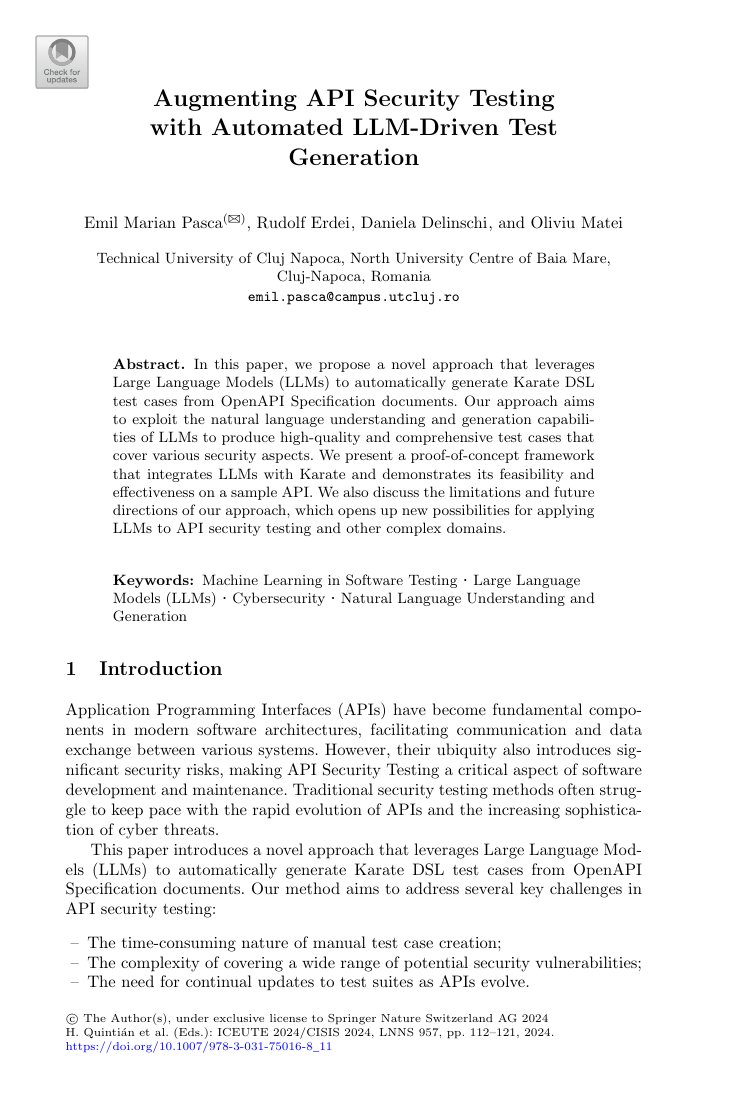
Augmenting API Security Testing with Automated LLM-Driven Test Generation
Augmenting API Security Testing with Automated LLM-Driven Test Generation
Emil Marian Pasca, Rudolf Erdei, Daniela Delinschi, Oliviu Matei
Abstract. API security testing is an essential step in modern software development, but manually crafting comprehensive test suites for security vulnerabilities is time-consuming and prone to human bias. This paper proposes a framework that augments API security testing with Large Language Model (LLM) driven automated test generation. The approach leverages LLMs to interpret OpenAPI specifications and produce contextually relevant security test cases that target common vulnerability classes (injection, broken object level authorization, mass assignment, etc.). The generated tests are integrated with established API testing pipelines to provide continuous and reproducible security validation. Initial experimental results indicate that the LLM-driven generation expands the coverage of security tests beyond what is typically achievable with rule-based or human-written test suites.
Keywords: API security; large language models; automated test generation; OWASP API Top 10; software testing
📋 Cite this publication
Emil Marian Pasca, Rudolf Erdei, Daniela Delinschi, Oliviu Matei, "Augmenting API Security Testing with Automated LLM-Driven Test Generation", Proc. 17th Int. Conf. on Computational Intelligence in Security for Information Systems (CISIS 2024), 2024, 2023.
Reference: Proc. 17th Int. Conf. on Computational Intelligence in Security for Information Systems (CISIS 2024), 2024.
Using Automation and Artificial Intelligence in the Management of European Social Fund Projects
Using Automation and Artificial Intelligence in the Management of European Social Fund...

Design of a collaborative network for mapping digital skills for Industry 5.0
Design of a collaborative network for mapping digital skills for Industry 5.0Maria Gustavsson,...
Solving the clustered minimum routing tree problem using Prüfer-coding based hybrid genetic algorithms
Solving the clustered minimum routing tree problem using Prüfer-coding based hybrid genetic...
Data Quality Assessment Methodology
Data Quality Assessment MethodologyDaniela Delinschi, Rudolf Erdei, Emil Pasca, Oliviu Matei...
Privacy Assessment Methodology for Machine Learning Models and Data Sources
Privacy Assessment Methodology for Machine Learning Models and Data SourcesRudolf Erdei, Emil...
Aggregation Strategy for Federated Machine Learning Algorithm
Aggregation Strategy for Federated Machine Learning AlgorithmRudolf Erdei, Daniela Delinschi,...
Using Markov chains for determining the proximity contagion of smart specialization of localities
Using Markov chains for determining the proximity contagion of smart specialization of...
Advancements in Machine Learning Algorithms for Precision Crop Yield Prediction: A Comprehensive Review with focus on European Union
Advancements in Machine Learning Algorithms for Precision Crop Yield Prediction: A Comprehensive...
TPC Net: An Efficient CNN Architecture for Tomato Plant Disease and Pest Classification
TPC Net: An Efficient CNN Architecture for Tomato Plant Disease and Pest ClassificationOvidiu...
Enhancing API Security Testing against BOLA and Authentication Vulnerabilities through an LLM-Enhanced Framework
Enhancing API Security Testing against BOLA and Authentication Vulnerabilities through an...
A new vision of social behavior on genetic algorithm performance
A new vision of social behavior on genetic algorithm performanceAndreea Tatar, Nicolae Fat, Adrian...
A comparative study of different genetic algorithms approaches to capacitated vehicle routing problem for collection of agricultural products
A comparative study of different genetic algorithms approaches to capacitated vehicle routing...

0 Comments