
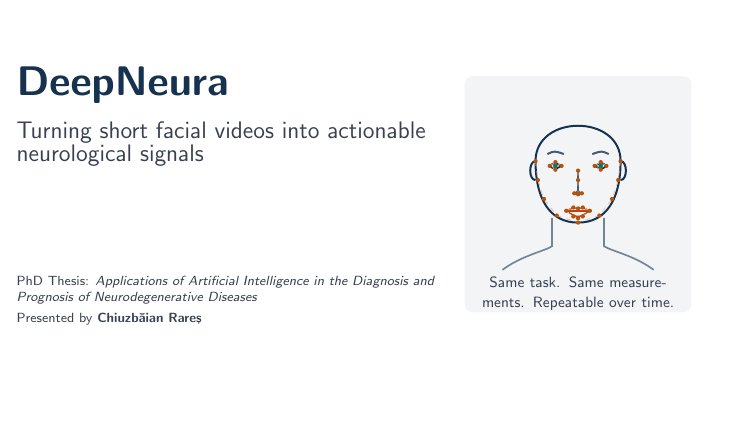
Chiuzbăian Rareș presented DeepNeura, a research project that turns short facial videos into actionable neurological signals — work that ties directly into his PhD thesis on Applications of Artificial Intelligence in the Diagnosis and Prognosis of Neurodegenerative Diseases.
The core idea
Video in — movement signal out — explanation attached. Same task, same measurements, repeatable over time. The system standardises a short guided facial video as the primary input, extracts motor signals from the visible movements, and produces a quantified measurement that can be tracked across visits and over the course of a disease.
Why video instead of lab tables
The pitch contrasted the proposed approach with classical tools: not lab-result tables, not Precision ALS / PRO-ACT tables — but short, structured facial videos. The signal that matters is the visible movement itself, captured in a way that is reproducible, comparable across patients and over time, and amenable to AI-based analysis.
From video to signal
The pipeline converts the video into a numerical signal that quantifies motor patterns relevant to neurodegenerative disease assessment, and attaches an explanation layer so that clinicians can understand the reasoning behind the produced measurement.
Connection to the COSA framework
Like AgriGuard, DeepNeura demonstrates how the AI-vision and signal-processing methods developed inside the COSA technology pipeline can be transferred to high-impact application domains beyond agriculture. The same research mindset — using everyday camera devices to produce reliable, repeatable measurements — applies here to neurology, where access to specialist examinations is often a bottleneck.
Presentation slides
View the full slide deck below — or open the PDF in a new tab / download.
If the PDF does not render in your browser, please use the "open" or "download" link above.

0 Comments