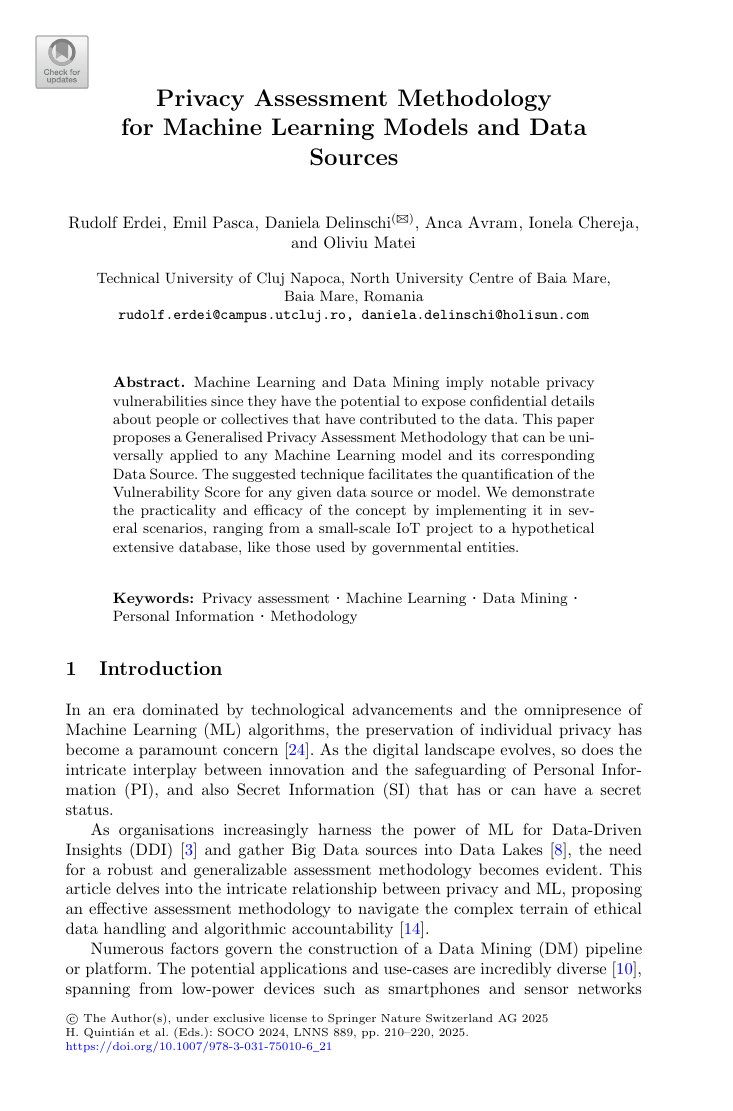
Privacy Assessment Methodology for Machine Learning Models and Data Sources
Privacy Assessment Methodology for Machine Learning Models and Data Sources
Rudolf Erdei, Emil Pasca, Daniela Delinschi, Anca Avram, Ionela Chereja, Oliviu Matei
Abstract. The widespread use of machine learning amplifies privacy risks both at the level of training data and at the level of the resulting models. This paper proposes a methodology for the joint privacy assessment of machine learning models and the data sources used to build them. The approach combines a structured inventory of data sources, threat scenarios and privacy-relevant model properties (memorisation, leakage potential, re-identification risk) with quantitative indicators that can be computed during the model lifecycle. The methodology supports compliance with privacy regulations and enables informed trade-offs between utility and privacy, with case studies drawn from agricultural and IoT data domains.
Keywords: privacy assessment; machine learning; data sources; privacy risk; data protection
📋 Cite this publication
Rudolf Erdei, Emil Pasca, Daniela Delinschi, Anca Avram, Ionela Chereja, Oliviu Matei, "Privacy Assessment Methodology for Machine Learning Models and Data Sources", Proc. 19th SOCO Int. Conf. on Soft Computing Models in Industrial and Environmental Applications, Springer, 2024, 2023.
Reference: Proc. 19th SOCO Int. Conf. on Soft Computing Models in Industrial and Environmental Applications, Springer, 2024.
Using Automation and Artificial Intelligence in the Management of European Social Fund Projects
Using Automation and Artificial Intelligence in the Management of European Social Fund...
Design of a collaborative network for mapping digital skills for Industry 5.0
Design of a collaborative network for mapping digital skills for Industry 5.0Maria Gustavsson,...
Solving the clustered minimum routing tree problem using Prüfer-coding based hybrid genetic algorithms
Solving the clustered minimum routing tree problem using Prüfer-coding based hybrid genetic...
Augmenting API Security Testing with Automated LLM-Driven Test Generation
Augmenting API Security Testing with Automated LLM-Driven Test GenerationEmil Marian Pasca, Rudolf...
Data Quality Assessment Methodology
Data Quality Assessment MethodologyDaniela Delinschi, Rudolf Erdei, Emil Pasca, Oliviu Matei...
Aggregation Strategy for Federated Machine Learning Algorithm
Aggregation Strategy for Federated Machine Learning AlgorithmRudolf Erdei, Daniela Delinschi,...
Using Markov chains for determining the proximity contagion of smart specialization of localities
Using Markov chains for determining the proximity contagion of smart specialization of...
Advancements in Machine Learning Algorithms for Precision Crop Yield Prediction: A Comprehensive Review with focus on European Union
Advancements in Machine Learning Algorithms for Precision Crop Yield Prediction: A Comprehensive...
TPC Net: An Efficient CNN Architecture for Tomato Plant Disease and Pest Classification
TPC Net: An Efficient CNN Architecture for Tomato Plant Disease and Pest ClassificationOvidiu...
Enhancing API Security Testing against BOLA and Authentication Vulnerabilities through an LLM-Enhanced Framework
Enhancing API Security Testing against BOLA and Authentication Vulnerabilities through an...
A new vision of social behavior on genetic algorithm performance
A new vision of social behavior on genetic algorithm performanceAndreea Tatar, Nicolae Fat, Adrian...
A comparative study of different genetic algorithms approaches to capacitated vehicle routing problem for collection of agricultural products
A comparative study of different genetic algorithms approaches to capacitated vehicle routing...

0 Comments