
Publications & Posters
Explore the comprehensive repository of journal papers and publications dedicated to the COSA project, showcasing groundbreaking research and innovative developments in this pioneering field.

[1] O. Cosma, P. C. Pop, and L. Cosma, “A hybrid based genetic algorithm for solving the clustered generalized traveling salesman problem,” Proc. Int. Conf. on Hybrid Artificial Intelligence Systems (HAIS), Springer, 2023, pp. 352–362. DOI: 10.1007/978-3-031-40725-3_30. (Reported to 15.10.2023 – report 1) [details]
[2] P. C. Pop, O. Cosma, C. Sabo, and C. P. Sitar, “A comprehensive survey on the generalized traveling salesman problem,” European Journal of Operational Research, vol. 308, Elsevier, 2023. DOI: 10.1016/j.ejor.2023.07.022. (Reported to 15.10.2023 – report 1) [details]
[3] C. Sabo, P. C. Pop, and A. Petrovan, “A comparison of different crossover operators in genetic algorithms for clustered shortest-path tree problem,” Proc. 50th Int. Conf. on Computers and Industrial Engineering (CIE 50), 2024. (Reported to 15.01.2024 – report 2) [details]
[4] M. T. Sattari, A. Avram, H. Apaydin, and O. Matei, “Evaluation of Feature Selection Methods in Estimation of Precipitation Based on Deep Learning Artificial Neural Networks,” Water Resources Management, vol. 37, Springer, 2023. DOI: 10.1007/s11269-023-03563-4. (Reported to 15.01.2024 – report 2) [details]
[5] O. Cosma, and L. Cosma, “A Novel CNN Approach for Accurate Tomato Disease Classification,” Proc. 30th ICE/IEEE ITMC Conf., IEEE, 2024. DOI: 10.1109/ICE/ITMC61926.2024.10794256. (Reported to 15.07.2024 – report 4) [details]
[6] M. Gustavsson, O. Matei, L. Andreica, A. H. Lundkvist, and D. P. Thunqvist, “Design of a collaborative network for mapping digital skills for Industry 5.0,” PRO-VE 2024 – 25th IFIP Working Conference on Virtual Enterprises, 2024. (Reported to 15.07.2024 – report 4) [details]
[7] C. Sabo, B. Teglaș, P. C. Pop, and A. Petrovan, “Solving the clustered minimum routing tree problem using Prüfer-coding based hybrid genetic algorithms,” Proc. 19th Int. Conf. on Hybrid Artificial Intelligence Systems (HAIS 2024), Springer, 2025, pp. 312–323. DOI: 10.1007/978-3-031-74183-8_26. (Reported to 15.07.2024 – report 4) [details]
[8] E. M. Pasca, R. Erdei, D. Delinschi, and O. Matei, “Augmenting API Security Testing with Automated LLM-Driven Test Generation,” Proc. 17th Int. Conf. on Computational Intelligence in Security for Information Systems (CISIS 2024), 2024. (Reported to 15.07.2024 – report 4) [details]
[9] D. Delinschi, R. Erdei, E. Pasca, and O. Matei, “Data Quality Assessment Methodology,” Proc. 19th SOCO Int. Conf. on Soft Computing Models in Industrial and Environmental Applications, Springer, 2024. (Reported to 15.07.2024 – report 4) [details]
[10] R. Erdei, E. Pasca, D. Delinschi, A. Avram, I. Chereja, and O. Matei, “Privacy Assessment Methodology for Machine Learning Models and Data Sources,” Proc. 19th SOCO Int. Conf. on Soft Computing Models in Industrial and Environmental Applications, Springer, 2024. (Reported to 15.07.2024 – report 4) [details]
[11] R. Erdei, D. Delinschi, I. Băărăian, and O. Matei, “Aggregation Strategy for Federated Machine Learning Algorithm,” Proc. 19th SOCO Int. Conf. on Soft Computing Models in Industrial and Environmental Applications, Springer, 2024. (Reported to 15.07.2024 – report 4) [details]
[12] O. Matei, L. Andreica, I. A. Danci, A. Avram, and B. Văduva, “Using Markov chains for determining the proximity contagion of smart specialization of localities,” Proc. 19th SOCO Int. Conf. on Soft Computing Models in Industrial and Environmental Applications, Springer, 2024. (Reported to 15.07.2024 – report 4) [details]
[13] C. Anton, A. Avram, O. Matei, L. Andreica, and B. Văduva, “Advancements in Machine Learning Algorithms for Precision Crop Yield Prediction: A Comprehensive Review with focus on European Union,” Proc. 19th SOCO Int. Conf. on Soft Computing Models in Industrial and Environmental Applications, Springer, 2024. (Reported to 15.07.2024 – report 4) [details]
[14] O. Cosma, and L. Cosma, “TPC Net: An Efficient CNN Architecture for Tomato Plant Disease and Pest Classification,” Proc. 19th SOCO Int. Conf. on Soft Computing Models in Industrial and Environmental Applications, Springer, 2024. DOI: 10.1007/978-3-031-75010-6_19. (Reported to 15.07.2024 – report 4) [details]
[15] E. M. Pasca, R. Erdei, D. Delinschi, and O. Matei, “Enhancing API Security Testing against BOLA and Authentication Vulnerabilities through an LLM-Enhanced Framework,” Proc. 19th SOCO Int. Conf. on Soft Computing Models in Industrial and Environmental Applications, Springer, 2024. (Reported to 15.07.2024 – report 4) [details]
[16] A. Tatar, N. Fat, A. Petrovan, and O. Matei, “A new vision of social behavior on genetic algorithm performance,” Proc. 19th SOCO Int. Conf. on Soft Computing Models in Industrial and Environmental Applications, Springer, 2024. (Reported to 15.07.2024 – report 4) [details]
[17] C. Sabo, N. Balogh, P. C. Pop, and A. Petrovan, “A comparative study of different genetic algorithms approaches to capacitated vehicle routing problem for collection of agricultural products,” Proc. 19th SOCO Int. Conf. on Soft Computing Models in Industrial and Environmental Applications, Springer, 2025, pp. 127–136. DOI: 10.1007/978-3-031-75010-6_13. (Reported to 15.07.2024 – report 4) [details]
[18] O. Matei, L. Andreica, I. A. Danci, A. Avram, and F. Tudor, “Using Machine Learning for Identifying the Intrinsic Economic Specializations of Localities,” Proc. 19th SOCO Int. Conf. on Soft Computing Models in Industrial and Environmental Applications, Springer, 2024. (Reported to 15.07.2024 – report 4) [details]
[19] B. Văduva, O. Matei, A. Avram, and L. Andreica, “Embedding GIS in crop field bonitation computation,” Proc. 19th SOCO Int. Conf. on Soft Computing Models in Industrial and Environmental Applications, Springer, 2024. (Reported to 15.07.2024 – report 4) [details]
[20] M. Mara, P. Pop, and J. Barata, “A comparative study of machine learning models for plant disease identification,” Proc. 19th SOCO Int. Conf. on Soft Computing Models in Industrial and Environmental Applications, Springer, 2024. (Reported to 15.07.2024 – report 4) [details]
[21] I. Cionca, A. D. Costin, and T. Rusu, “Optimizing fertilization and crop management for triticale in the Lăpuș depression, Romania,” AgroLife Scientific Journal, vol. 14, no. 2, 2024. DOI: 10.17930/AGL202426. (Reported to 15.01.2025 – report 6) [details]
[22] M. Oliviu, L. Andreica, and F. Tudor, “Using Automation and Artificial Intelligence in the Management of European Social Fund Projects,” Proc. ProjMAN International Conference on Project Management, 2025. (Reported to 15.01.2025 – report 6) [details]
[23] M. Oliviu, L. Andreica, and F. Tudor, “Benefits and limitations of digitalization in managing European Social funded projects,” Proc. ProjMAN International Conference on Project Management (Poster Paper), 2025. (Reported to 15.01.2025 – report 6) [details]
[24] I. Chereja, R. Erdei, E. Pasca, D. Delinschi, A. Avram, and O. Matei, “A Privacy Assessment Framework For Data Tiers In Multilayered Ecosystem Architectures,” Mathematics (Basel), vol. 13, no. 7, MDPI, 2025. DOI: 10.3390/math13071116. (Reported to 15.04.2025 – report 7) [details]
[25] E. M. Pasca, D. Delinschi, R. Erdei, and O. Matei, “LLM-Driven, Self-Improving Framework for Security Test Automation: Leveraging Karate DSL for Augmented API Resilience,” IEEE Access, vol. 13, 2025. DOI: 10.1109/ACCESS.2025.3554960. (Reported to 15.04.2025 – report 7) [details]
[26] O. S. Mintas, D. C. Marele, A. S. Stanciu, A. G. Osicianu, A. S. Osiceanu, H. Pop, and T. Rusu, “Sustainability of the Integrated Waste Management System: A Case Study of Bihor County, Romania,” Sustainability (Basel), MDPI, 2025. (Reported to 15.04.2025 – report 7) [details]
[27] I. Chereja, R. Erdei, D. Delinschi, E. Pasca, A. Avram, and O. Matei, “Privacy-Conducive Data Ecosystem Architecture: By-Design Vulnerability Assessment Using Privacy Risk Expansion Factor and Privacy Exposure Index,” Sensors (Basel), vol. 25, no. 11, MDPI, 2025. DOI: 10.3390/s25113554. (Reported to 15.07.2025 – report 8) [details]
[28] E. M. Pasca, D. Delinschi, R. Erdei, I. Băărăian, and O. Matei, “A Vulnerable-by-Design IoT Sensor Framework for Cybersecurity in Smart Agriculture,” Agriculture (Basel), vol. 15, no. 12, MDPI, 2025. DOI: 10.3390/agriculture15121253. (Reported to 15.07.2025 – report 8) [details]
[29] D. Delinschi, R. Erdei, E. Pasca, I. Băărăian, and O. Matei, “Guide in Designing an Asynchronous Performance-Centric Framework for Heterogeneous Microservices in Time-Critical Cybersecurity Applications. The BIECO Use Case,” Expert Systems, Wiley, 2025. DOI: 10.1111/exsy.70064. (Reported to 15.07.2025 – report 8) [details]
[30] I. Băărăian, R. Erdei, R. Tamaian, D. Delinschi, E. Pasca, and O. Matei, “Trend-Enabled Recommender System with Diversity Enhancer for Crop Recommendation,” Agriculture (Basel), vol. 15, no. 15, MDPI, 2025. DOI: 10.3390/agriculture15151614. (Reported to 15.10.2025 – report 9) [details]
[31] B. Văduva, A. Avram, O. Matei, L. Andreica, and T. Rusu, “A GIS-Driven, Machine Learning-Enhanced Framework for Adaptive Land Bonitation,” Agriculture (Basel), vol. 15, no. 16, MDPI, 2025. DOI: 10.3390/agriculture15161735. (Reported to 15.10.2025 – report 9) [details]
[32] C. Sabo, P. C. Pop, B. Teglaș, and A. Petrovan, “Competition between Dandelion and Prüfer encoded genetic algorithms for solving the clustered minimum routing tree problem,” Carpathian Journal of Mathematics, vol. 41, no. 4, 2025, pp. 1045–1059. DOI: 10.37193/CJM.2025.04.13. (Reported to 15.10.2025 – report 9) [details]
[33] M. Măcelaru, P. C. Pop, R. Chiuzbăian, and N. Kovacs, “An Enhanced Hybrid Machine Learning Model for Plant Disease Detection and Classification,” Proc. 20th Int. Conf. on Hybrid Artificial Intelligence Systems (HAIS 2025), Lecture Notes in Computer Science, vol. 16202, Springer, Cham, 2026, pp. 91–102. DOI: 10.1007/978-3-032-08465-1_8. (Reported to 15.01.2026 – report 10) [details]
Augmenting API Security Testing with Automated LLM-Driven Test Generation
Augmenting API Security Testing with Automated LLM-Driven Test GenerationEmil Marian Pasca, Rudolf Erdei, Daniela Delinschi, Oliviu Matei Abstract. API security testing is an essential step in modern software development, but manually crafting comprehensive test...
Data Quality Assessment Methodology
Data Quality Assessment MethodologyDaniela Delinschi, Rudolf Erdei, Emil Pasca, Oliviu Matei Abstract. High-quality data is a precondition for reliable machine learning, analytics and decision support. This paper introduces a methodology for systematic data quality...
Privacy Assessment Methodology for Machine Learning Models and Data Sources
Privacy Assessment Methodology for Machine Learning Models and Data SourcesRudolf Erdei, Emil Pasca, Daniela Delinschi, Anca Avram, Ionela Chereja, Oliviu Matei Abstract. The widespread use of machine learning amplifies privacy risks both at the level of training data...
Aggregation Strategy for Federated Machine Learning Algorithm
Aggregation Strategy for Federated Machine Learning AlgorithmRudolf Erdei, Daniela Delinschi, Iulia Băărăian, Oliviu Matei Abstract. Federated learning allows multiple parties to collaboratively train a model without sharing their raw data, but the quality of the...
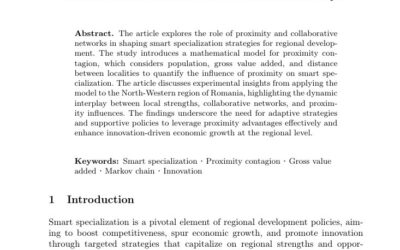
Using Markov chains for determining the proximity contagion of smart specialization of localities
Using Markov chains for determining the proximity contagion of smart specialization of localitiesOliviu Matei, Laura Andreica, Ioan Alin Danci, Anca Avram, Bogdan Văduva Abstract. Smart specialization strategies depend on understanding how economic specialization...
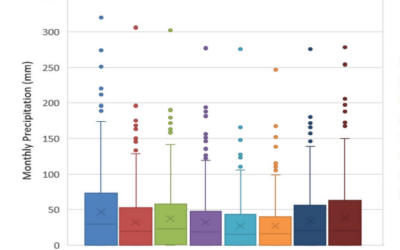
Evaluation of Feature Selection Methods in Estimation of Precipitation Based on Deep Learning Artificial Neural Networks
Precipitation is the most important element of the water cycle and an indispensable element of water resources management. This paper aims to model the monthly precipitation in 8 precipitation observation stations. The effects and role of different feature weights pre-processing methods (Weight by deviation, Weight by PCA, Weight by correlation, and Weight by Support Vector Machine) on artificial intelligence modeling were investigated.